ClearFlow Analytics in Action
Chattanooga, Tennessee - 39 event days analyzed across 10,934 pipe segments
See the live dashboard
Overview Dashboard
For Decision Makers:
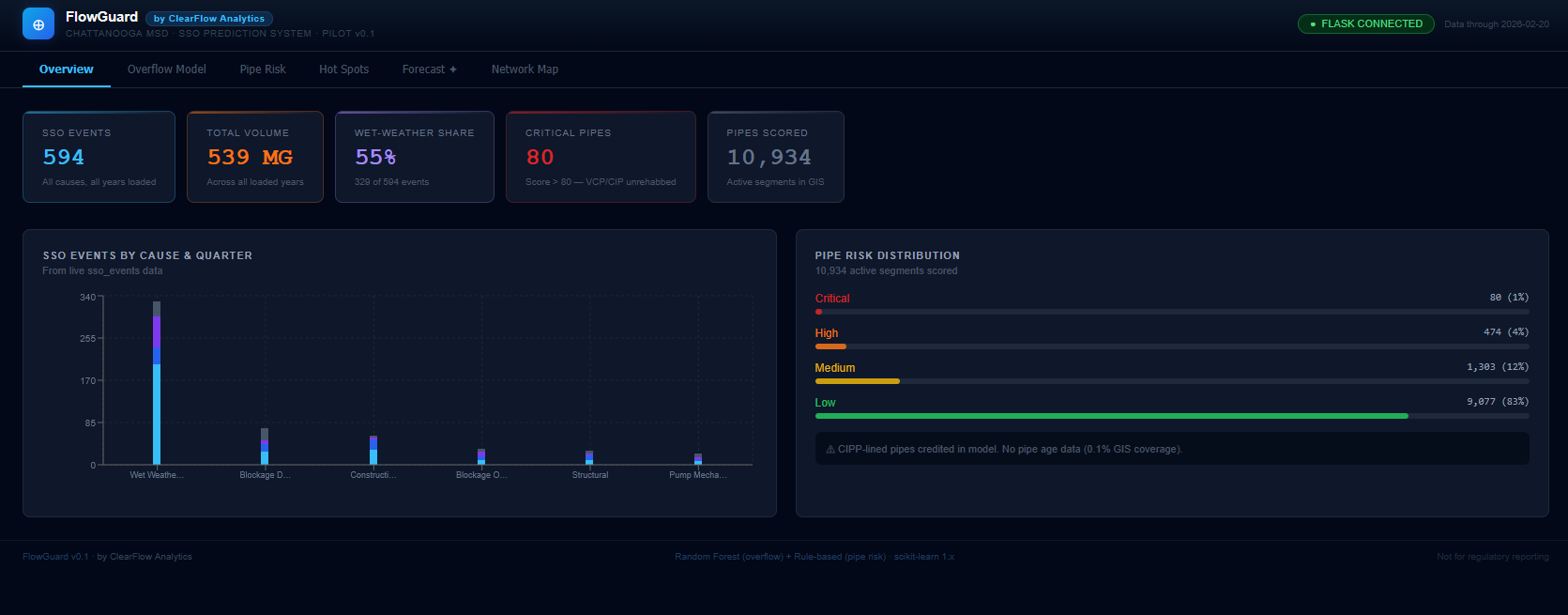
 The Overview Dashboard provides executive visibility into system health and risk distribution. At a glance, see total event counts, critical pipe segments requiring attention, and historical patterns by cause.
For Technical Teams:
Integrates 39 event days of labeled data (2021-2025) with real-time weather and soil moisture monitoring. The model uses Random Forest classification on features including rainfall patterns (1d, 7d, 14d rolling windows), soil saturation, and infrastructure attributes. Performance metrics show 95.4% ROC-AUC with conservative threshold calibration for operational deployment.
Key Features:
Overflow Model
For Decision Makers:
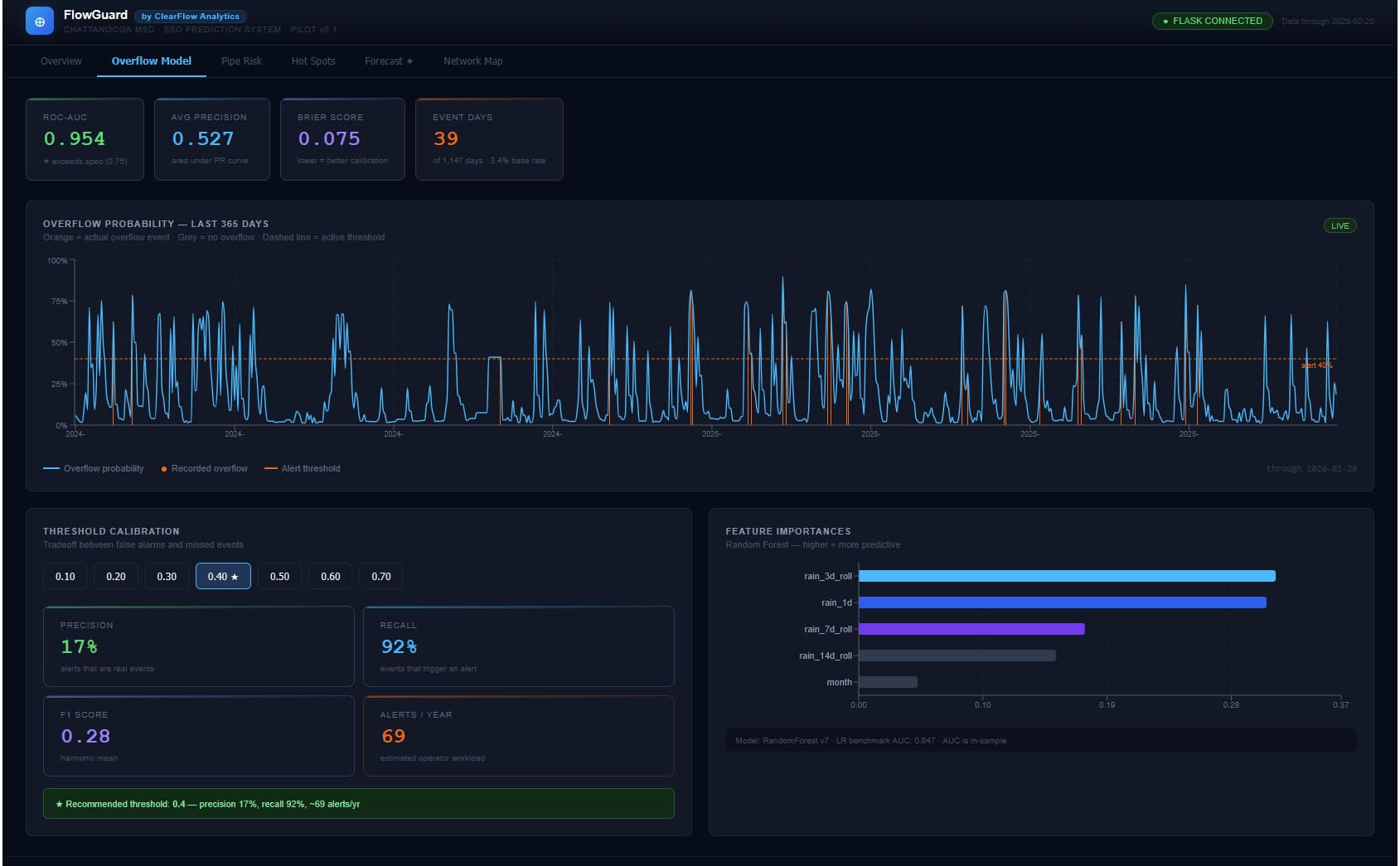
This view shows model confidence and accuracy metrics. The 'Alert Threshold' slider lets operators adjust sensitivity—set lower for maximum safety (more alerts), higher to reduce false alarms.
For Technical Teams:
Precision-recall tradeoffs displayed for operational threshold selection. Current deployment threshold (0.40) yields 17% precision, 92% recall with F1-score 0.28—prioritizing overflow prevention over false positive minimization. Model evaluated on 1,147 labeled days with 39 overflow events (3.4% event rate).
Key Features:
Pipe Risk
For Decision Makers:
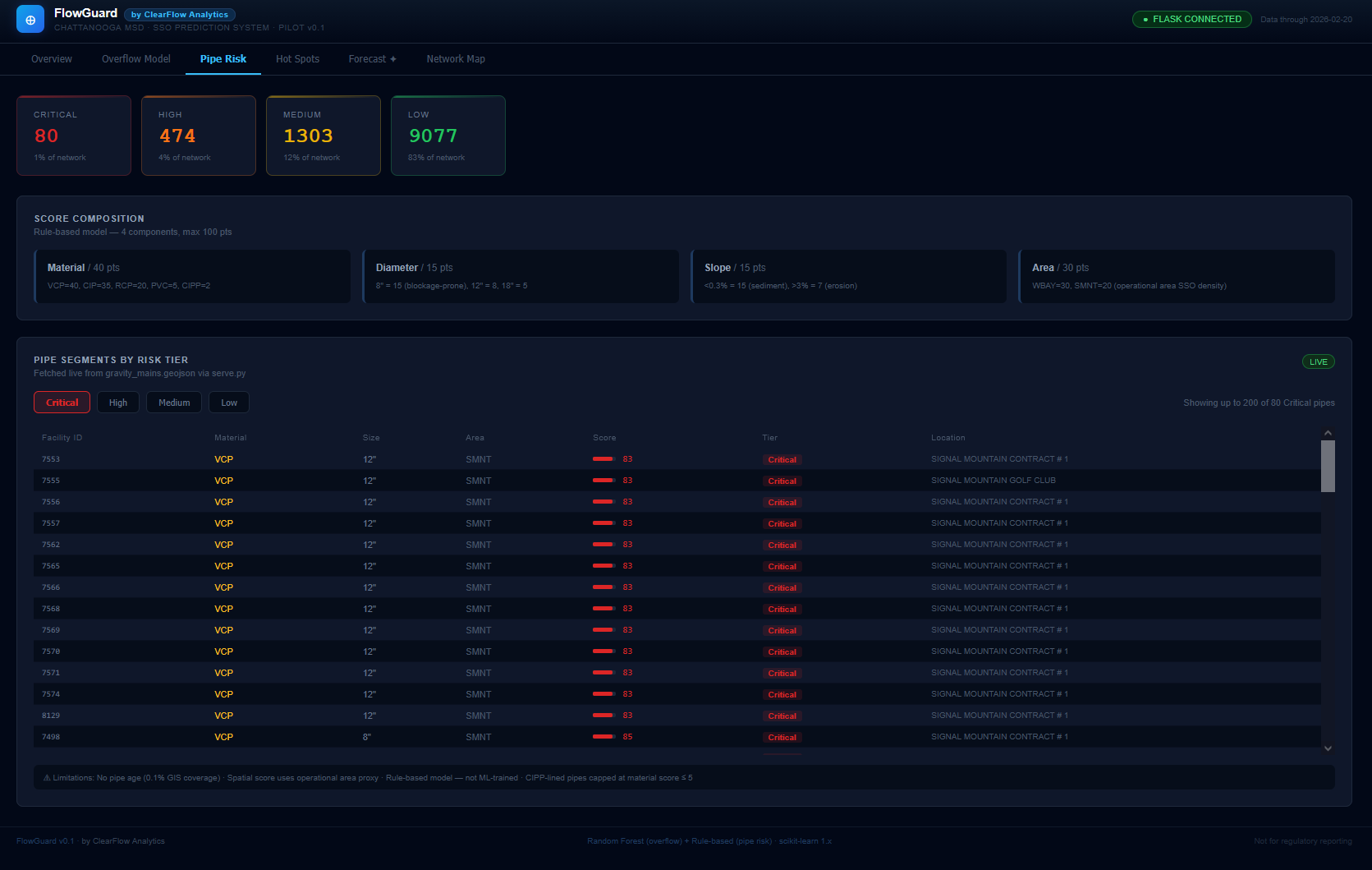
The Pipe Risk view identifies specific manholes and pipe segments requiring immediate attention. Each facility receives a risk score (0-100) updated continuously as conditions change.
For Technical Teams:
Segment-level risk scoring based on ensemble predictions across infrastructure attributes (material, diameter, slope, spatial location) and environmental conditions. Score composition analysis breaks down contributions from material type, geometry, and spatial clustering. Top risk segments table provides facility IDs for immediate field deployment.
Key Features:
Hot Spots
For Decision Makers:
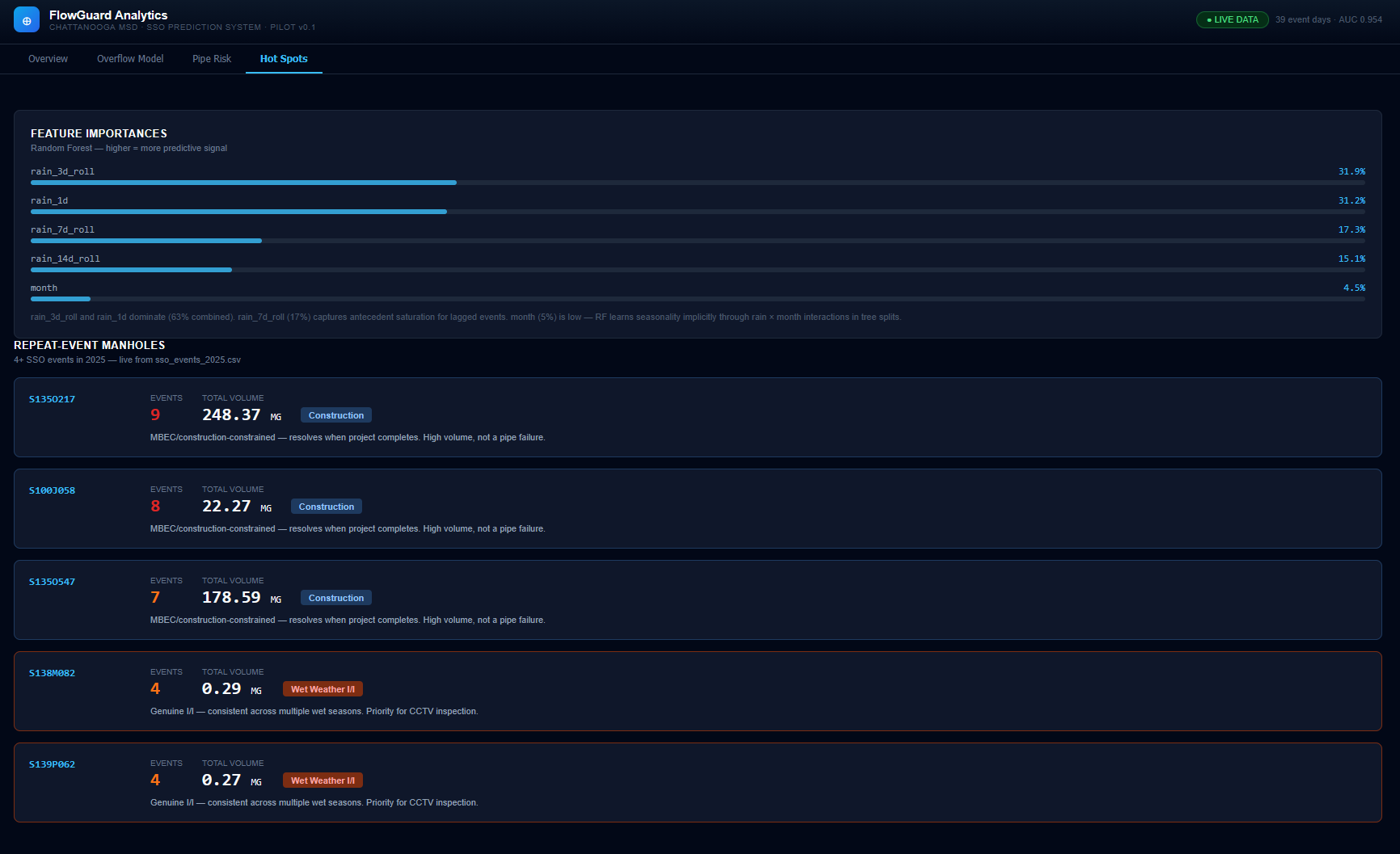
Hot Spots identifies repeat problem areas—manholes that overflow multiple times require infrastructure investment, not just reactive maintenance.
For Technical Teams:
Repeat event analysis from SSO events, obtained through the open data hub, identifying chronic problem facilities. Feature importance confirms rainfall patterns dominate (rain_3d_roll, rain_1d, rain_7d_roll account for 63% combined), with seasonal factors (month) contributing 4.5%. Construction-related events show distinct patterns resolved upon project completion.
Key Features:

Transforming Raw Predictions into Actionable Insights

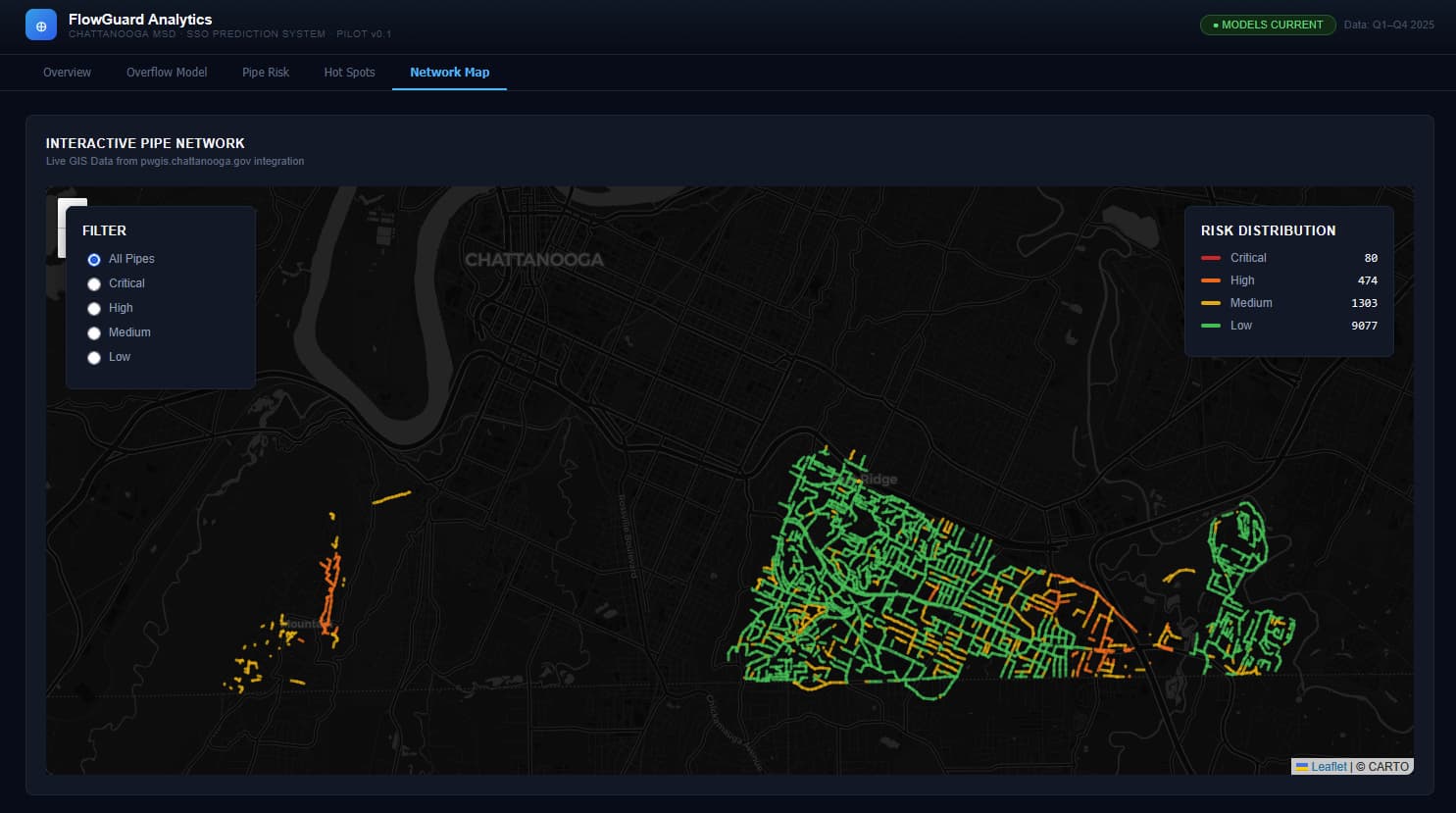
Data is only as good as its accessibility. FlowGuard Analytics integrates seamlessly with existing municipal GIS data to provide a 'Live' risk map of the entire sewer network.

Feature 1: The Risk Distribution Dashboard
With live GIS data.
Comprehensive System Overview
Stop reacting to breaks and start predicting them. Our dashboard categorizes every pipe segment in the city—from 'Critical' to 'Low' risk—allowing for long-term capital improvement planning based on empirical data, not guesswork.
Feature 2: Pinpoint Accuracy
Segment-Level Intelligence
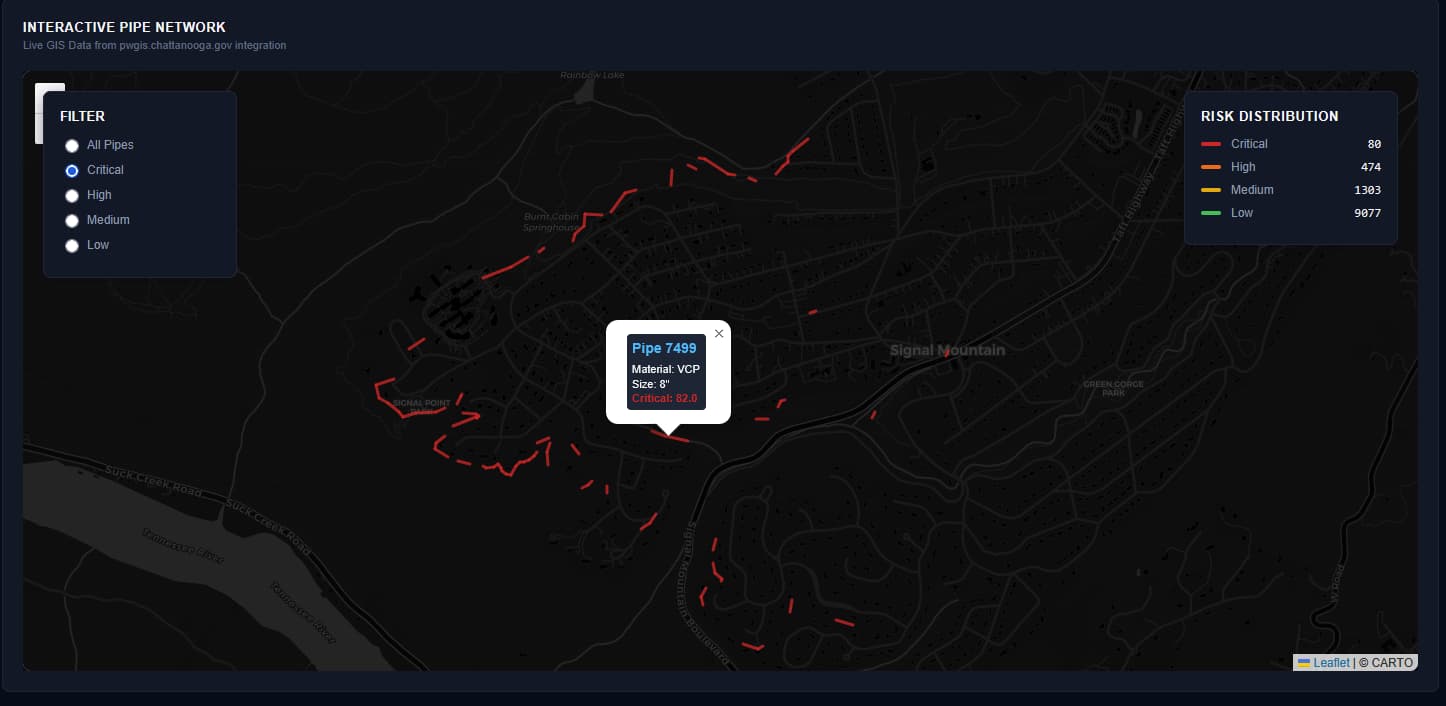
Avoid the 'shotgun approach' to repairs. By identifying specific high-risk segments (e.g., Pipe 7499), cities can target maintenance where it is needed most. This granular detail is the key to reducing Sanitary Sewer Overflows (SSOs) and satisfying EPA consent decrees.
Feature 3: Smart Resource Allocation
Filtered Prioritization
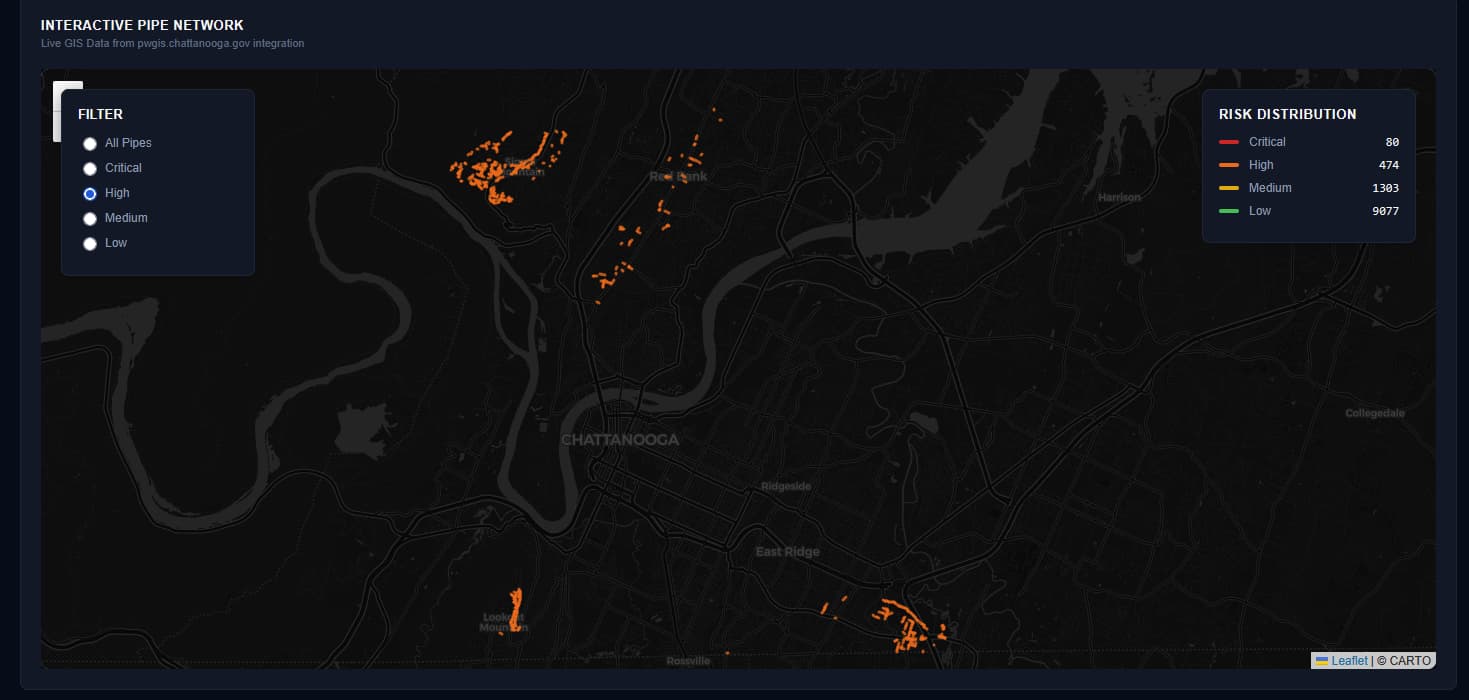
Public Works budgets are tight. Our interactive filtering allows departments to isolate the top 5% of 'at-risk' infrastructure instantly. By focusing on these high-probability failure points, cities can proactively prevent the environmental and financial catastrophes of a major pipe failure.
Ready to See What ClearFlow Can Do For Your Utility?
Pilot Program Benefits:
The ROI of Predictive Mapping: